
01Access control and automation
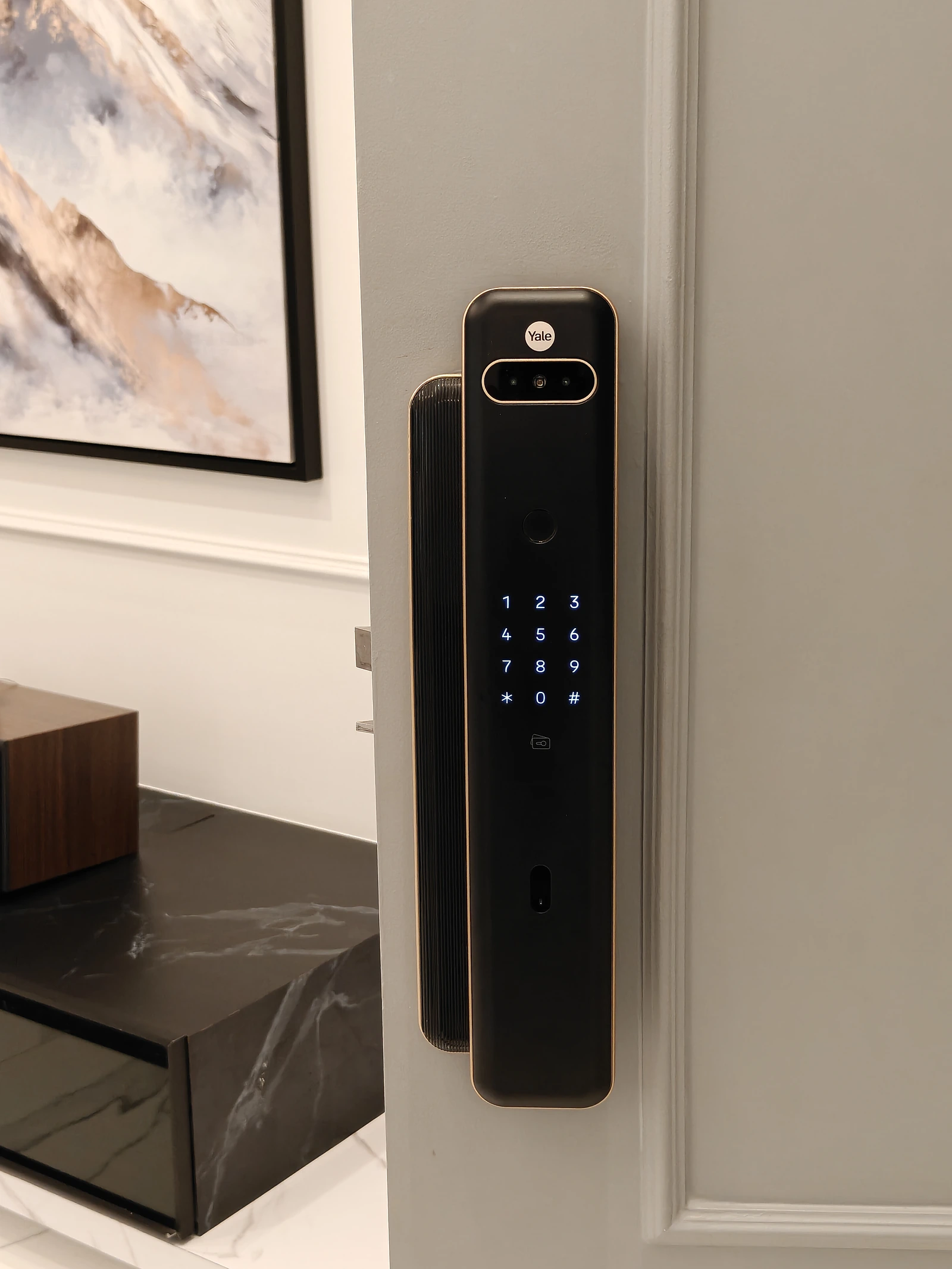
Modern residences may use fingerprint readers, PINs, mobile credentials or other access methods. When access control is integrated with automation, an authorised entry can trigger appropriate lighting, climate or welcome scenes.
Access events should be designed carefully with attention to privacy, user permissions and fallback methods.
02Door and window sensors
Contact sensors can provide information about whether doors or windows are open. That information can be useful for notifications, security logic or other automation functions.
For example, selected alerts can be generated when a door is left open, or certain automation behaviours can change when the home is in an away mode.
Goodnight from a bedroom keypad can arm the cameras, drop the temperature and lock the front door.
03Cameras and video systems
Security cameras are specialist systems that can be integrated with a broader smart-home experience. The objective is usually not to replace a dedicated security platform but to connect relevant information and controls.
Network design is particularly important because cameras and other connected systems generate data. A properly designed wired and wireless network supports reliability and performance.
04Lighting as a security layer
Lighting can support security by creating appropriate visibility around entrances, passages and outdoor areas. An away scene can also manage selected lights according to programmed schedules.
Automation should never be presented as a substitute for professional security assessment. It is one layer within a broader security strategy.
05Away and night modes
A well-designed away mode can combine multiple functions: selected lights off, climate settings adjusted, curtains controlled, access secured and security systems placed into the appropriate state.
A night mode can be different, keeping essential pathways illuminated while reducing unnecessary lighting elsewhere.
06Privacy and local control
Connected homes should be designed with privacy in mind. Homeowners should understand which functions operate locally, which depend on internet services and how user accounts and remote access are secured.
Professional network segmentation, strong credentials, firmware management and sensible permissions are as important as the automation logic.
07The role of a professional integrator
Security-related automation should be engineered carefully because incorrect logic can create inconvenience or false confidence. The integrator should document what each security state does and how the homeowner can override or recover from it.
The best result is a system that adds useful coordination while keeping the home effortless to operate.
08Frequently Asked Questions
Does home automation replace a security system?
No. Automation can integrate with security equipment, but dedicated security design and professional assessment remain important.
Can security work without internet?
Some core functions can be designed to operate locally. Remote access and cloud features may require internet connectivity.
Can access control trigger lighting?
Yes, where the access-control system and automation architecture support the integration.
Speak with Control Valley about integrating access, security, lighting and networking into a coherent residential automation plan.
—Continue reading
- What Is KNX Home Automation? A Complete Guide for HomeownersWhat KNX home automation is, how it works, what it can control, and why it suits homes designed to stay useful for years.
- KNX vs Wi-Fi Smart Home: Which Is Better for a New Home?KNX vs Wi-Fi smart home explained: compare reliability, scalability, wiring, security, control, maintenance and cost before choosing automation for a new home.
- How Much Does Home Automation Cost in India? A Practical GuideUnderstand how home automation is priced in India, what shapes the budget, what a KNX project includes, and how to plan a realistic scope.